

Technique Summary
Journals provide a place for individual designers to record ideas, so unlike most co-design activities, this technique encourages working as an individual. Because of this, journals are usually used in short bursts (around 10 minutes), in conjunction with another technique. This may come anytime during a session.
When and why to use this technique
Journals provide a place for individual designers to record ideas, so unlike most co-design activities, this technique encourages working as an individual. Because of this, journals are usually used in short bursts (around 10 minutes), in conjunction with another technique. This may come anytime during a session.
Supplies and Preparation
- Supplies: one blank, hard-covered, unlined paper in journal for each co-designer (these encourage both drawing and writing); writing implements (i.e., pencils, crayons, markers, etc. – anything that does not bleed through the paper in the journal).
How to use this technique
- Journals can be used in many ways – for note taking, for quickly jotting down ideas, etc.
- Encourage co-designers to date any entry into their journals so they can be connected with the design session and design task that was happening at the time.
- Co-designers should understand that like other design artifacts, journals will be used for design. In this way, they are design artifacts rather than personal diaries, and other members of the co-design team might be looking at each others’ journals just like they would with any other design artifact.
- Sometimes, design partners may request to have their journals during small group design work.
- Journals are often a good place to start brainstorming individual ideas. Journals can be a place where individual ideas are captured and logged, which may help co-designers to get these ideas down and then feel more comfortable working in small groups to design.
- Journals will not typically be a technique used for an entire design session.
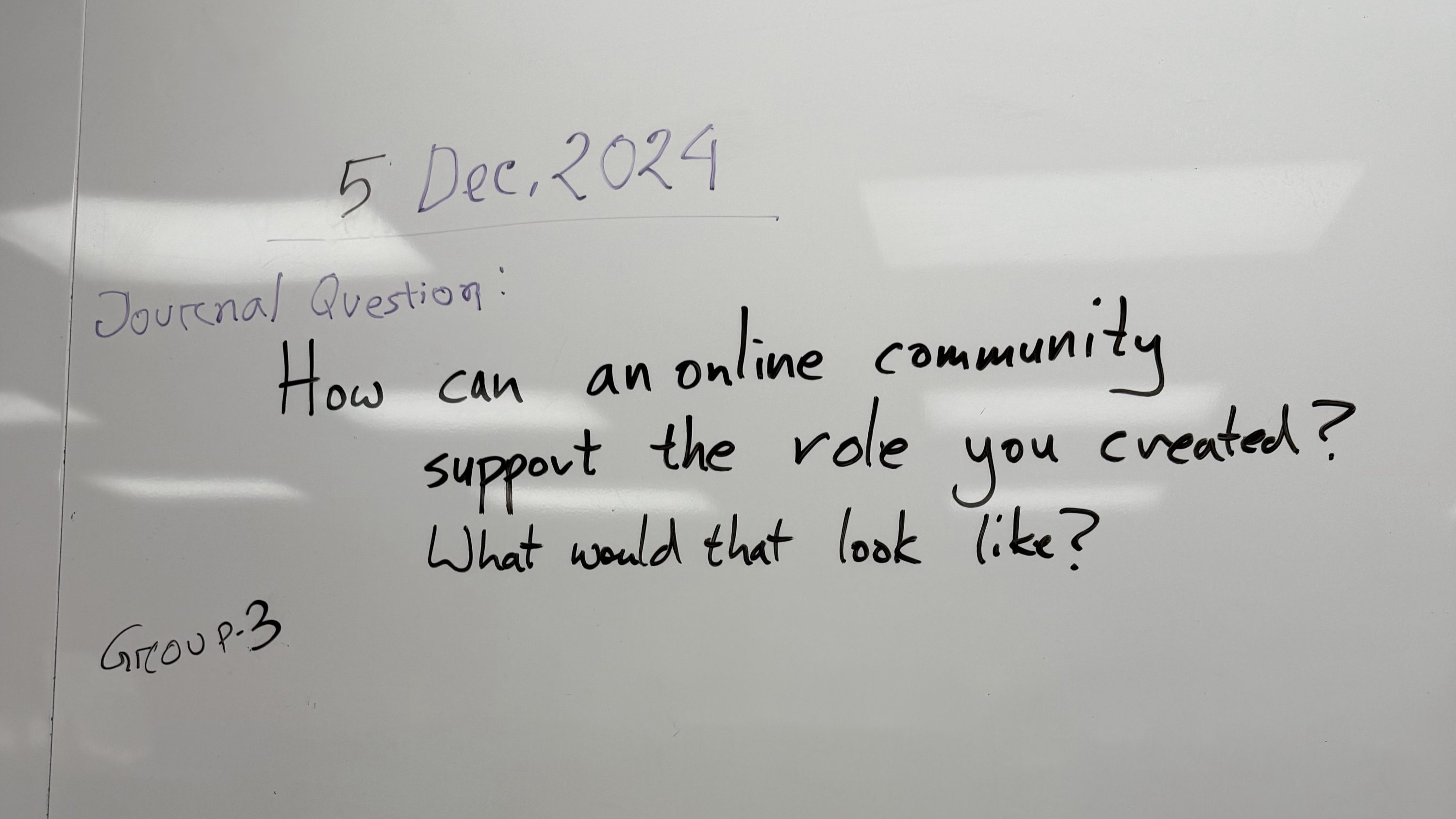
- You may also ask co-designers to respond to a design prompt posed to the whole group.
- Journaling can be done online. Using a simple text-based program such as Google Docs can work for any age. If children would also like to be able to draw, look for a program that supports this such as Google slides. You might find that older children (ages 12+) prefer to have an online journaling option whether the design session itself is in person or online.
See this technique in action
References
Druin, A. (2002). The role of children in the design of new technology. Behaviour and Information Technology, 21(1), 1-25.
Fails, J.A., Guha, M.L., & Druin, A. (2013). Methods and Techniques for Involving Children in the Design of New Technology for Children. Foundations and Trends in Human-Computer Interaction 6(2).
Fails, J.A., Ratakonda, D.K., Koren, N., Elsayed-Ali, S., Bonsignore, E., and Yip, J. (2022). Pushing boundaries of co-design by going online: Lessons learned and reflections from three perspectives. International Journal of Child-Computer Interaction 33: 100476.